
Loading...
Loading...
GRC software looks simple on the surface. Under the hood, regulatory depth, cross-functional workflows, and audit-grade evidence chains make it one of the hardest enterprise categories to get right.
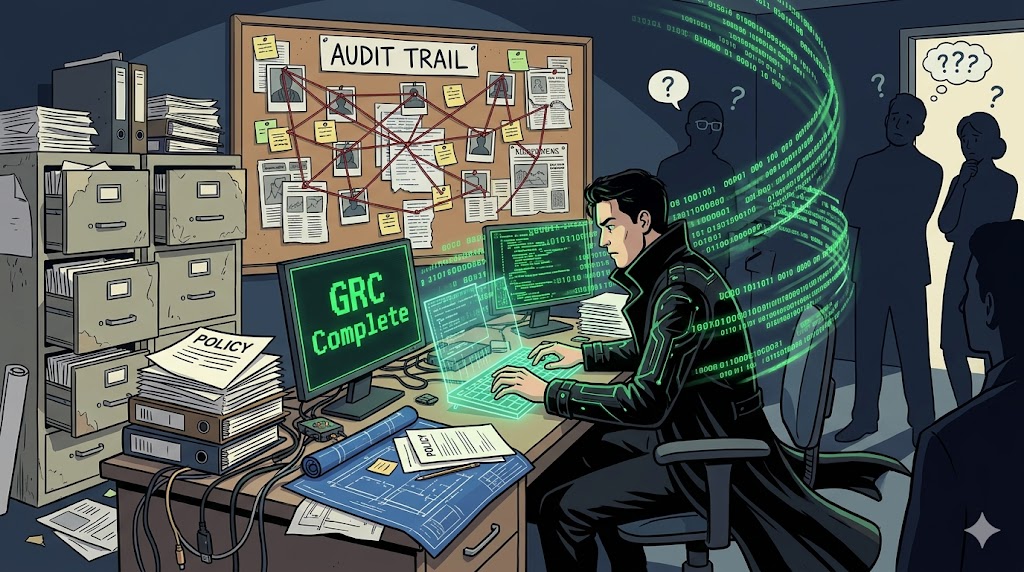
A post went viral after RSA this year. The gist: "649 exhibitors. 61.9% could be replaced by a weekend of vibe-coding in Cursor."
It got laughs. It got reshares. And for most of the cybersecurity market, it might even be partially true. Plenty of tools really are just dashboards on top of a database.
But in GRC? Not a chance.
Governance, Risk and Compliance software is one of the most deceptively complex categories in enterprise technology. It looks simple on the surface. Underneath, it's a tangle of regulatory logic, multi-stakeholder workflows, and evidence chains that would break most weekend prototypes before Monday morning.
Here's why.
It's tempting to think compliance is just a checklist. Map your controls to a framework, tick the boxes, generate a report. Done.
Except regulations overlap, contradict each other, and change constantly. DORA went live in January 2025. NIS2 is being transposed differently across every EU member state. The AI Act introduces risk tiers that interact with existing data protection rules in ways nobody has fully mapped yet.
A GRC platform doesn't just store these frameworks. It needs to understand the relationships between them. When a single control satisfies requirements from ISO 27001, SOC 2, and DORA simultaneously, the software needs to track that mapping, keep it current, and surface gaps when one framework updates and the others don't.
Try vibe-coding that. You'll have a prototype that looks right and fails the first time an auditor asks "show me how this control satisfies requirement 5.2.3 of DORA and which evidence supports it."
GRC is not one person doing one thing. It's dozens of people across multiple functions, each with different responsibilities, permissions, and timelines.
A risk assessment alone might involve:
Each of those people needs a different view. Different permissions. Different notification triggers. Different approval chains.
Now multiply that across every risk, every control, every policy, every incident. The workflow engine inside a serious GRC platform is handling thousands of interconnected tasks with complex dependency chains, escalation rules, and delegation logic.
This isn't a UI problem. It's an orchestration problem. And orchestration at this scale, with this many stakeholders, is exactly where prototypes fall apart.
In most software, logging is a nice-to-have. In GRC, it's the entire point.
Regulators don't accept "trust us, we're compliant." They want evidence. Timestamped, attributed, immutable evidence. Who approved this policy? When was this risk last reviewed? What changed between the last assessment and this one? Can you prove it?
An audit trail in GRC software isn't a log file. It's a legal record. It needs to capture every action, every change, every approval, and present it in a format that satisfies external auditors and regulatory examiners.
Build that in a weekend? You might get a changelog. You won't get something that holds up when the FCA comes knocking.
GRC doesn't exist in a vacuum. It sits at the intersection of nearly every business function.
A compliance management module needs to pull employee data from HR systems to track training completion. A third-party risk module needs feeds from procurement and vendor management. An incident management module needs to ingest alerts from security tooling, IT service management, and potentially legal case systems.
Each integration brings its own data model, its own API quirks, its own authentication requirements, and its own change cadence. A vendor that's been in the market for five years has battle-tested integrations with dozens of enterprise systems. That institutional knowledge, the workarounds, the edge cases, the "this particular SAP configuration breaks the sync unless you do X", is worth more than most people realise.
This is perhaps the most important point. Sergej Epp nailed it in his RSA post: most companies aren't buying software. They're buying confidence they don't have internally.
In GRC, that confidence gap is enormous. Most organisations don't have deep regulatory expertise in-house. They don't have dedicated teams who understand the nuance of every framework. They rely on their GRC vendor to encode that knowledge into the product: the right default workflows, the right control mappings, the right assessment templates.
When a CISO or Head of Compliance chooses a GRC platform, they're not just buying features. They're buying the accumulated expertise of a team that lives and breathes this domain. They're buying ongoing updates when regulations change. They're buying support from people who've seen the same audit scenario 200 times before.
No amount of vibe-coding replaces that.
It means due diligence matters more in GRC than in almost any other software category. The difference between a vendor that truly handles regulatory complexity and one that's just painted a compliance dashboard on top of a task manager isn't visible in a demo. It only surfaces when the real work starts.
This is exactly why we built Applied Verdict. Our assessment methodology tests what GRC software actually does against the Jobs to be Done that real buyers care about. Not feature lists. Not marketing claims. Structured, independent evaluation of whether the product handles the complexity you're about to throw at it.
Because in GRC, the stakes are too high for "it looked good in the demo."
Applied Verdict provides independent, structured assessments of GRC software. We test what matters to buyers, not what vendors want to show you. Learn more about our methodology.